


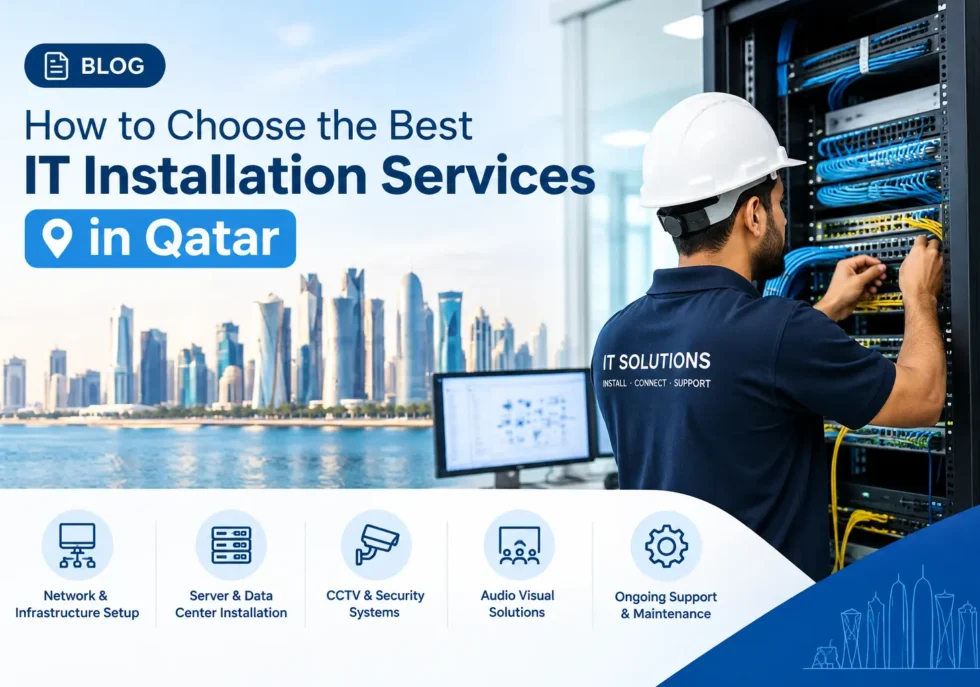

A poorly installed IT network can cost a business more than the installation itself. Unstable connections, inadequate cabling, security gaps, and equipment that cannot support business growth can lead to downtime, repeated repair costs, and operational disruptions.
Qatar’s ICT market is projected to grow from USD 19.91 billion in 2026 to USD 37.74 billion by 2031, according to Telecom Review Middle East. As businesses expand their digital operations, choosing reliable IT installation services Qatar businesses can depend on is essential for building infrastructure that supports current needs and future expansion.
The right installation partner should do more than set up equipment. They should assess your requirements, recommend suitable systems, complete the installation correctly, and verify that everything works before handover.
TL;DR
- Choose a provider offering networking, cabling, security, and support.
- Check technician expertise, equipment quality, and testing procedures.
- Match services to your office size, users, and growth plans.
- Inhand Qatar provides IT and digital business services under one team.
| Table of ContentsWhat Are IT Installation Services in Qatar?Why Do Businesses Need Professional IT Installation Services Qatar?What Services Should an IT Installation Company in Qatar Provide?Look for Quality Equipment and Professional InstallationHow to Assess Your IT Installation RequirementsWhy Choose Inhand Qatar for IT Installation Services?FAQ |
What Are IT Installation Services in Qatar?
IT installation services in Qatar cover the setup, configuration, testing, and documentation of a business’s technology infrastructure. These services can include structured cabling, network equipment, Wi-Fi, servers, CCTV, access control, and workstation setup.
A professional installation also includes configuration, testing, and documentation. The goal is to ensure that devices communicate correctly, employees can access the systems they need, and the network remains manageable as the business grows.
Why Do Businesses Need Professional IT Installation Services Qatar?
Businesses need professional IT installation services to establish reliable connectivity, reduce technical problems, and build infrastructure that can support future growth. Poorly installed networks can result in connectivity issues, security weaknesses, downtime, and additional repair costs.
Qatar’s digital transformation market is projected to grow from USD 10.68 billion in 2026 to USD 22.59 billion by 2031, according to Mordor Intelligence. As more businesses depend on cloud applications, connected devices, digital payments, and remote access, reliable infrastructure becomes essential to daily operations.
Poor installation can create problems that are difficult to identify later. Incorrect cable termination may cause intermittent connectivity, poorly positioned access points can leave parts of an office with weak Wi-Fi, and unsuitable network equipment may struggle as more users and devices are added.
Professional installation helps businesses:
- Reduce network interruptions and troubleshooting time
- Improve connectivity across workspaces
- Establish better cable organisation and device management
- Support security systems and controlled access
- Prepare the infrastructure for future expansion
- Avoid repeated installation and repair costs
A properly planned setup also makes future maintenance easier because cables, ports, devices, and network components are clearly identified.
What Services Should an IT Installation Company in Qatar Provide?
A professional IT installation company in Qatar should provide services covering networking, structured cabling, servers, security systems, workstations, and post-installation support. The exact combination should depend on the size, layout, systems, and operational requirements of your business.
A capable provider should offer services that cover the main technology requirements of your office.
- Structured Cabling
Structured cabling supports data, voice, and network connectivity throughout the workplace. The provider should plan cable routes, label connections, manage cable organisation, and test each installation before completion.
- Network Setup
This includes configuring routers, switches, firewalls, Wi-Fi access points, and related network equipment. The setup should account for the number of users, connected devices, internet requirements, and expected network traffic.
- Server Installation
Businesses that use on-site or hybrid systems may require server installation, configuration, storage setup, and network integration. The provider should confirm that the server environment supports the applications and access requirements of the business.
- Security System Installation
Depending on the site, this may include CCTV, access control, surveillance integration, and related security equipment. Camera placement and access permissions should be planned according to the office layout and security requirements.
- Workstation and Peripheral Setup
For new offices and expansions, installation may include desktop computers, printers, monitors, scanners, and other connected devices. A standardised setup helps employees begin work with fewer technical issues.
Businesses may also require audio visual installation Qatar services for meeting rooms, conference spaces, training rooms, and presentation areas. This can include displays, projectors, speakers, video conferencing equipment, and related connectivity.
- Ongoing Support and Maintenance
Ask whether the provider offers maintenance after installation. A support agreement can help businesses address network faults, device failures, configuration issues, and future changes without searching for a new technician each time.
If a provider offers only one part of the setup, you may need to coordinate several vendors. This can make troubleshooting slower when a problem involves multiple systems.
Look for Quality Equipment and Professional Installation
Equipment quality and installation both affect your network’s reliability. A low-cost quotation may become expensive if it includes unsuitable hardware, poor cabling, or incomplete testing.
Before selecting a provider, ask the following questions:
| What to Check | Why It Matters |
| Equipment brands and specifications | Ensures the hardware suits your user count and workload |
| Technician experience | Reduces installation errors and configuration issues |
| Cabling standards and labelling | Makes maintenance and troubleshooting easier |
| Testing procedures | Confirms that connections and devices work correctly |
| Warranty and replacement terms | Clarifies what happens when equipment fails |
| Documentation | Gives your team a record of the installed infrastructure |
| Maintenance support | Helps resolve issues after the project is completed |
Ask for a written scope of work that clearly lists the equipment, installation tasks, testing procedures, and handover requirements.
Where structured cabling is involved, the provider should follow recognised cabling practices and use suitable testing equipment. The final handover should include relevant test results, network details, and device information.
How to Assess Your IT Installation Requirements
Assess your users, devices, office layout, security requirements, building constraints, and future growth before requesting an IT installation quotation. A clear requirements list helps providers prepare a more accurate scope and allows you to compare quotations on the same basis.
Before contacting an installer, define what your business actually needs. This helps you compare quotations accurately and prevents you from paying for equipment or services that are unnecessary.
- Count Your Users and Devices
List your employees, computers, phones, printers, access points, cameras, and other connected devices. This gives the installer a clearer picture of the network capacity required.
- Plan for Business Growth
Consider whether you expect to add employees, expand to another floor, introduce more devices, or increase your use of cloud applications. Planning for future demand can reduce the need for major changes later.
- Identify Security Requirements
Decide whether your business needs CCTV, access control, restricted server access, or other security measures. The requirements will depend on your office layout, industry, equipment, and access policies.
If your office includes meeting or training spaces, include audio visual installation Qatar requirements in the initial assessment. This helps the installer plan power, connectivity, display equipment, and other infrastructure alongside the network setup.
- Check Building Constraints
The building structure can affect installation methods. Older offices, rented spaces, and multi-floor buildings may require specific cable routes, conduits, ceiling access, or alternative connectivity options.
- Decide on Maintenance Expectations
Determine whether you need ongoing technical support, scheduled maintenance, emergency assistance, or only one-time installation. Clarifying this before signing the contract helps avoid confusion after project completion.
A reliable installer should ask these questions during the initial assessment. If a provider gives a quotation without understanding your office layout, device count, and future requirements, the scope may not accurately reflect your needs.
Why Choose Inhand Qatar for IT Installation Services?
Inhand Qatar can also support related digital requirements through services such as SEO, web development, and digital marketing company in Qatar solutions. Its broader service offering can be useful for businesses that need both technology support and digital business services from one provider.
When assessing Inhand for an installation project, businesses should confirm the exact IT services required, the equipment included, installation timelines, testing procedures, and post-installation support. A clear project scope helps ensure that the proposed setup matches the office’s operational requirements.
The company’s wider digital service portfolio also allows businesses to coordinate related requirements, such as website development, online product management, and digital marketing, without treating these as part of the IT installation itself.
Planning an office technology setup in Qatar?
Get in touch with Inhand Qatar to discuss your requirements and request a suitable installation scope.
FAQ
- How do I choose the best IT installation company in Qatar?
Choose a provider based on itsservice coverage, technical expertise, equipment quality, installation process, references, and post-installation support. Ask for a written scope of work and confirm that testing and documentation are included. Experience with offices similar to yours is also useful when comparing providers.
- What should I check before hiring an IT installation service?
Check whether the provider assesses your office layout, user count, device requirements, network capacity, security needs, and future expansion plans. You should also confirm the equipment brands, warranty terms, installation timeline, and maintenance options before signing an agreement.
- How much does IT installation cost in Qatar?
The cost depends on office size, cable length, network equipment, number of devices, security systems, and installation complexity. Request an itemised quotation that separates equipment, labour, testing, and maintenance so you can compare proposals accurately.
- How long does IT installation take for a business?
The timeline depends on the size and complexity of the project. A small office setup may take a few working days, while larger offices involving structured cabling, server configuration, and security systems may require several weeks.
- What is included in professional IT installation services?
Professional installation may include structured cabling, network hardware setup, Wi-Fi configuration, server installation, workstation setup, security system integration, testing, and documentation. The exact scope should be confirmed in the project quotation.
- Do I need professional IT installation for my small business?
Professional installation helps small businesses establish reliable connectivity and avoid problems caused by poor cabling, incorrect configurations, or unsuitable equipment. It also makes future expansion easier when more employees, devices, or systems are added.
- What is the difference between IT installation and IT maintenance?
IT installation involves setting up and configuring technology infrastructure, while IT maintenance focuses on keeping those systems working after deployment. Businesses may need both services to manage faults, upgrades, equipment changes, and ongoing performance.
- Should I choose a provider that also offers digital services?
If your business needs marketing support alongside technology services, working with a digital marketing company in Qatar can simplify coordination for related digital requirements. However, the provider’s IT installation expertise should remain the main consideration for an infrastructure project.